Subterranean termite infestations in Denver County stem primarily from the arid-land subterranean termite, which exploits foundation cracks as narrow as 1/32 of an inch. In historic brick bungalows across Baker,…
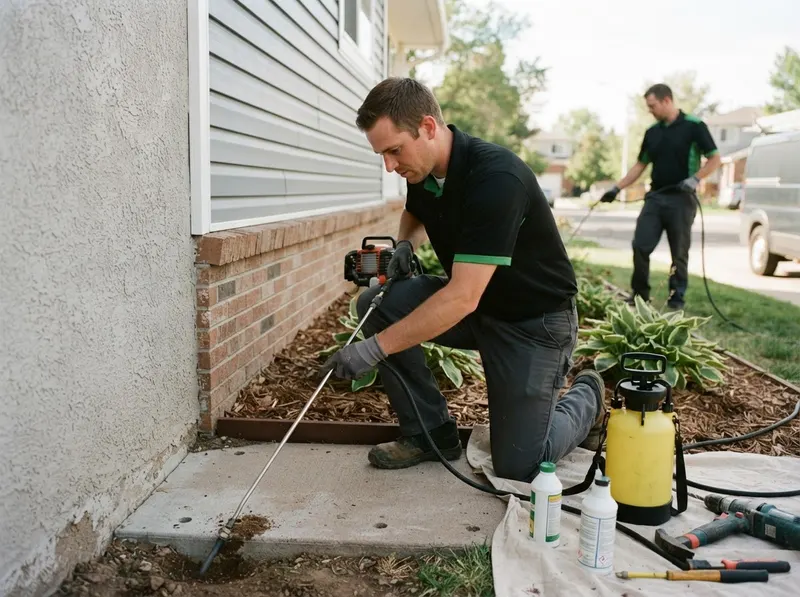
Subterranean termite infestations in Denver County stem primarily from the arid-land subterranean termite, which exploits foundation cracks as narrow as 1/32 of an inch. In historic brick bungalows across Baker, Washington Park, and Capitol Hill, sandstone foundations and rubble footings settle over decades, producing ground-level entry portals directly adjacent to structural floor joists. Because Denver soils dry out rapidly at 5,280 feet, subterranean termites migrate deep into moist crawlspaces and soil pockets beneath heated basement slabs. Surface sprays from retail stores fail because subterranean colonies live 4 to 10 feet subterraneanly; contact sprays kill only foraging workers, leaving the reproductive queen intact to produce thousands of additional eggs.
Effective structural defense requires an uninterrupted chemical or physical envelope. For homes built on slab foundations, common in Central Park (formerly Stapleton) and Montclair, specialists drill vertical holes spaced 12 inches apart through attached concrete patios, garages, and front stoops to saturate the underlying earth with non-repellent termiticide. For properties in Highland, Sloan's Lake, and Five Points featuring unexcavated dirt crawlspaces, technicians trench the soil 6 inches wide by 6 inches deep along all stem walls and piers, applying 4 gallons of termiticide solution per 10 linear feet. Workers pass freely through the treated zone without detection, transferring the active agent throughout the subterranean nest via social grooming.
Decision guidance depends on foundation construction and ground exposure. A liquid perimeter barrier provides immediate transfer to foraging insects, making it suitable for active, structural crises where mud tubes span concrete stem walls in Cherry Creek basements. In contrast, subterranean baiting systems install flush with turf grass along the dripline, avoiding concrete drilling; bait systems fit yards bordered by extensive hardscaping or stone walkways near City Park and Cheesman Park, though bait stations require 30 to 90 days to achieve full colony suppression as termites consume cellular matrices impregnated with insect growth regulators. Properties with exterior wood-to-ground contact require mechanical clearance of structural timbers prior to chemical injection to prevent structural failure.
Every job gets a firm, written price after a free on-site visit.
Tell us about your subterranean termite treatment job in Denver and we'll send a clear, written quote, usually the same day.
 Maviron Pest Services